

When speed becomes noise

How fast decisions can introduce instability in complex systems
This article is part of a broader line of work on systems, structure, and decision-making developed at Inratios.
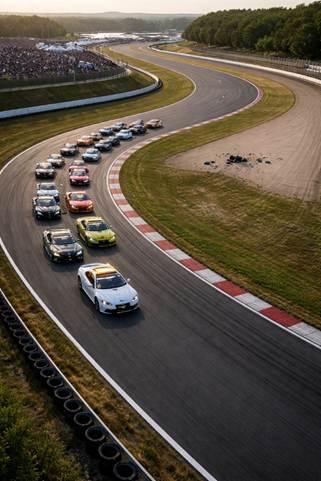
Speed sets the pace. It doesn’t reveal what lies ahead.
The promise of speed
Speed feels like control. When pressure rises, movement reassures and decisions signal leadership. Action creates the sense that something is being done. In crises, in organizations, and in markets, speed is often treated as a virtue in itself. Fast responses look decisive. They reduce discomfort. They quiet the room. For a moment, uncertainty seems contained.
This intuition is understandable. In simple situations, speed works. When cause and effect are clear, acting quickly can prevent damage. Delay feels irresponsible. Hesitation feels dangerous. That intuition carries over into complex situations almost automatically. Unfortunately, in complex systems, that intuition often comes at a cost. When information is incomplete and stakes are high, speed becomes the default response. Slowing down feels risky. Acting feels responsible. But in complex systems, that sense of progress is often misleading. What looks like movement can be little more than noise.
The conditions under which speed works
Speed is effective only under specific conditions. It works when the system is simple enough for cause and effect to remain stable. When actions lead to predictable outcomes. When feedback is fast, direct, and unambiguous. And when mistakes can be detected and corrected before they cascade.In such systems, acting quickly reduces risk. Delay increases exposure. The faster response is not just efficient, it is appropriate.
But these conditions are rarely present in complex systems. As complexity increases, relationships become non-linear. Feedback is delayed or distorted. Interventions change the system they are meant to correct. What looks like a contained action begins to ripple across interconnected parts. Speed does not fail because it is wrong. It fails because the conditions that made it effective no longer exist.
When speed crosses into noise
The shift from simple to complex is not always obvious. At first, systems may still appear manageable. Signals look familiar. Patterns seem to repeat. Decisions feel justified. Speed continues to produce movement, and movement is easily mistaken for progress.
But something subtle changes.
In complex systems, action no longer just responds to reality. It begins to shape it. Every intervention alters the conditions under which the next decision is made. Feedback arrives late or distorted. Effects appear far from their original cause. At that point, speed no longer reduces uncertainty. It accelerates interaction before meaning has had time to form. Decisions are made faster than the system can be understood. Signals multiply. Interpretations diverge. What once felt like clarity becomes a stream of competing indicators. The system grows louder, not clearer. This is where speed turns into noise.
Fast decisions can be necessary to keep a system from failing. But using those decisions as a basis for understanding or planning is where instability quietly takes root. The faster decisions are taken, the harder it becomes to distinguish signal from reaction. Interventions trigger responses that look like new information, but are often just echoes of earlier moves. The system starts responding to itself. What feels like decisiveness is, in fact, a loss of orientation.
When speed destabilizes systems
Once speed crosses into noise, instability does not arrive suddenly. It builds gradually.
Each fast intervention slightly alters the system. Not always in visible ways, but enough to change how the next signal is produced and interpreted. Decisions are made on feedback that is already shaped by earlier actions. The system begins to drift, even as it appears active and responsive. What makes this particularly dangerous is that the system often looks functional. Processes continue. Metrics update. Output resumes. The sense of urgency fades, replaced by the comfort of movement. It feels as if control has been restored. But stability is not the same as health.
When speed is used to compensate for incomplete understanding, systems do not settle. They harden. Temporary fixes become structural dependencies. Early assumptions solidify into constraints that are no longer questioned. What started as a response to urgency quietly becomes the new normal. This is how instability persists without being recognized.
- In organizations, this shows up as repeated restructurings, shifting priorities, and recurring “root causes” that never quite disappear.
- In crises, it appears as containment without resolution.
- In markets, as volatility driven by reactions to reactions rather than underlying conditions.
- In healthcare, it emerges when care focuses on stabilizing presentation rather than understanding the underlying condition. Clinical reasoning is meant to prevent exactly that shift. When it is bypassed, the system may continue to function, but fragility accumulates beneath the surface.
The faster the system is pushed to respond, the less room remains to see what is actually changing. Speed narrows perception. It privileges immediate signals over structural patterns. Over time, the system becomes harder to read, not because it is more complex, but because it has been reshaped too quickly to understand.
At that point, instability is no longer an external threat.
It is being produced from within.
Two speeds, two logics
At this point, a crucial distinction begins to matter.
- Not all urgency is the same.
- And not all speed serves the same purpose.
In crises, speed is used to prevent collapse. The goal is containment. To secure what must keep running. To limit damage while uncertainty is still high. Fast decisions are often necessary, but they are deliberately narrow. They are meant to stabilize, not to explain.
In change, speed serves a different function. Here, action is part of learning. Interventions are reversible. Feedback is used to refine understanding. Movement is not about control, but about exploration. Problems arise when these two logics are confused.
Crisis speed applied to change leads to exhaustion. Organizations keep intervening, restructuring, and correcting, while the underlying pattern remains untouched. Everything moves, but nothing settles.
Change logic applied to crises creates a different failure. Endless analysis replaces decisive containment. While understanding deepens, control quietly erodes.
Both failures stem from the same mistake: treating speed as a single dimension, instead of recognizing that it serves different purposes depending on the situation.
This is why speed alone is never the right question. The real question is what the speed is meant to achieve.
Seeing before speed
When speed becomes noise, the problem is rarely execution, it is perception. Most systems do not fail because people act too slowly. They fail because action begins before the situation is truly understood. Once interventions start shaping the system, it becomes harder to see what is signal and what is reaction. Clarity erodes quietly, while activity continues. This is why seeing must come before speed. Not as a delay. Not as a procedural step.
But as the first and most consequential intervention. In complex systems, the quality of the picture determines the quality of everything that follows. Decisions do not compensate for poor perception. Faster action does not correct a distorted frame. It only reinforces it.
The paradox is that restraint at the front end often creates momentum later. Systems that invest time in forming a reliable picture require fewer interventions, fewer corrections, and less force to stay on course. What looks slow at the beginning frequently proves faster over time. This is also where many organizations lose their footing. Once things appear to be running again, attention shifts forward. Planning resumes. Optimisation accelerates. The system moves on, often without returning to the question of whether the underlying instability was ever addressed. What remains is motion without orientation.
Seeing before acting is not about caution. It is about legitimacy. It acknowledges that in complex systems, not every move is justified simply because it is possible. Some actions reduce uncertainty. Others only amplify it. Knowing the difference is what separates control from activity. That is why speed is never a goal in itself. And why clarity is never optional.