
E-book Shapes in Proportion
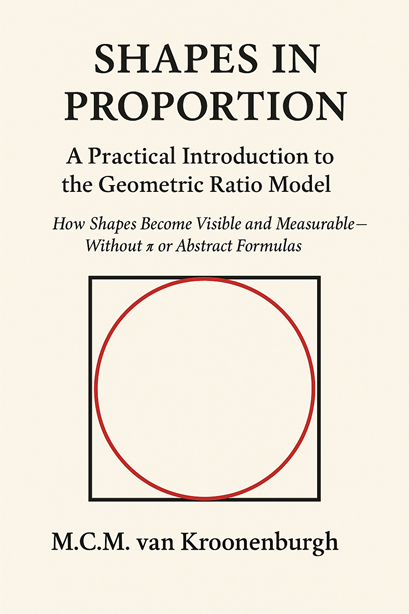
A journey through circles, squares, and fixed shape ratios
For centuries, π has played a central role in how we mathematically describe the circle.
But in a world that’s becoming increasingly digital, visual, and fast-paced, there’s growing need for a complementary perspective, one where shapes are not calculated, but compared using fixed ratios.
Shapes in Proportion introduces the Geometric Ratio Model (GRM):
a new way to approach geometry, where ratios function as an extra dimension of understanding.
This book takes you into the world of circles and squares, and shows how fixed proportions, such as the Square Perimeter Unit (SPU) and Square Area Unit (SAU, create a simple, consistent, and visually applicable measurement logic, designed for today’s digital reality.
It’s a system that works in both 2D and 3D, offering a universal approach to shape recognition and measurement, without π.
Who is this book for?
This book is written for anyone curious about shapes, proportions, and a new way of looking at geometry.
Whether you’re a beginner who always found math difficult,
or a professional working with form, data, or logic, this book reveals that geometry can also be visual, intuitive, and surprisingly simple.
In a world that is increasingly digital, geometry demands a new approach;
one that works not just on paper, but also in software, AI, design, and education.
Shapes in Proportion offers an accessible and powerful stepping stone.
Ideal for anyone who wants to be ready for the (digital) future of geometry.
What you can expect
✅ A fresh perspective on classical shapes
✅ Measurement methods without π or square roots
✅ Clear explanations on thinking in ratios
✅ Practical ratios for use in education, design, and AI
✅ Visual illustrations that bring the theory to life
Availability
The book will soon be available as an e-book (2025)
Once the book is live, you’ll find the direct link here.
About the Author
M.C.M. van Kroonenburgh is a systems thinker, creator of the GRM model, and a thinker in proportions.
Driven by his fascination for simplicity within complexity, he works on innovative ways to make geometry understandable, consistent, and applicable — both within and beyond mathematics.